writing / reporting
How a Fake Massachusetts Gravis Poll Spread on Twitter
A fabricated poll, borrowed branding, and a trusted acquaintance. Reporting from August 2020 on how false Massachusetts polling numbers reached a wider audience.
From the archive. First published by Elections Today on August 28, 2020; recovered through the Wayback Machine and republished here on September 6, 2026. This edition has been edited for clarity and length. Quotations retain their original wording, and account statuses refer to the time of reporting.
With the Massachusetts primaries approaching, polling was drawing attention to the Democratic Senate race and the contests in the 1st and 4th Congressional Districts. On August 28, 2020, a document presented as a Gravis Marketing poll began circulating on Twitter. Its results conflicted with recent polling, but some national and regional writers shared them.
The document was fabricated. The reporting linked two Twitter accounts, @JohnMcCormackMA and @Kilometerbryman, to its creation and release. By the time of the original article, the first account had been deleted and the second had been made private.
How the numbers reached an audience
Jessy Han, a cohost of the Cape Cod Cabin podcast, publicly acknowledged that he had shared the false poll. In a correction, he said he had deleted the related tweets and asked others to do the same.
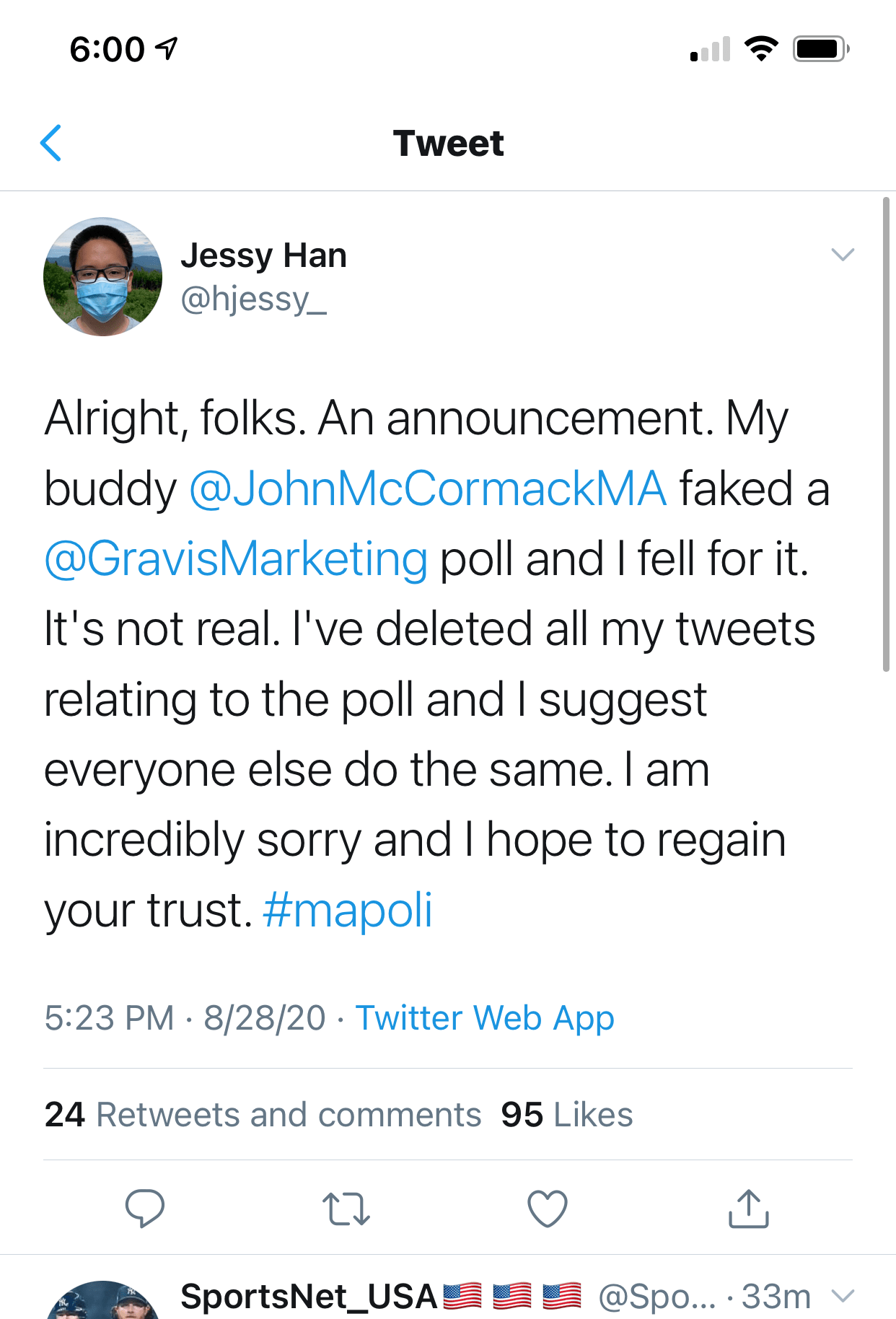
We spoke with Han for the original report. He described how an acquaintance had sent him the document:
“I was sent the poll from a twitter user named ‘Speaker John McCormack’. He hinted to me that they had access to the poll and wanted someone to leak it yesterday, they sent it to me this afternoon and I published the results on my Twitter page. They went to extreme lengths to fabricate the numbers and cross tabs so I would believe them and even made fake graphics to go with it. The individual is an acquaintance of mine, so I gave him the benefit of the doubt.”
Borrowed branding and fabricated results
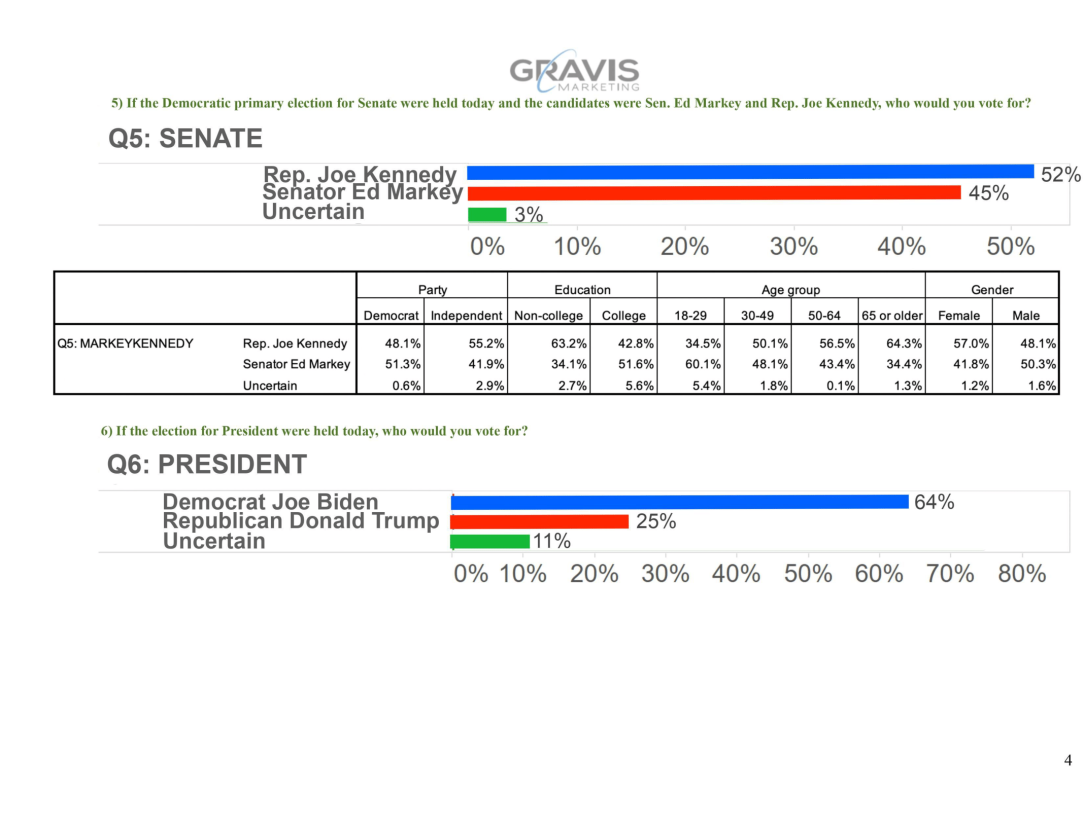
The material used Gravis Marketing branding, charts, and demographic cross-tabulations to resemble a polling report. The example below is one of the fabricated graphics reproduced in the original article. Its numbers should not be treated as polling data.
The accounts’ responses
The original report noted that @JohnMcCormackMA acknowledged being behind the false poll before deleting the account. It also included images of direct messages, posted by @Kilometerbryman, that appeared to show discussion of creating and releasing fabricated polling numbers.
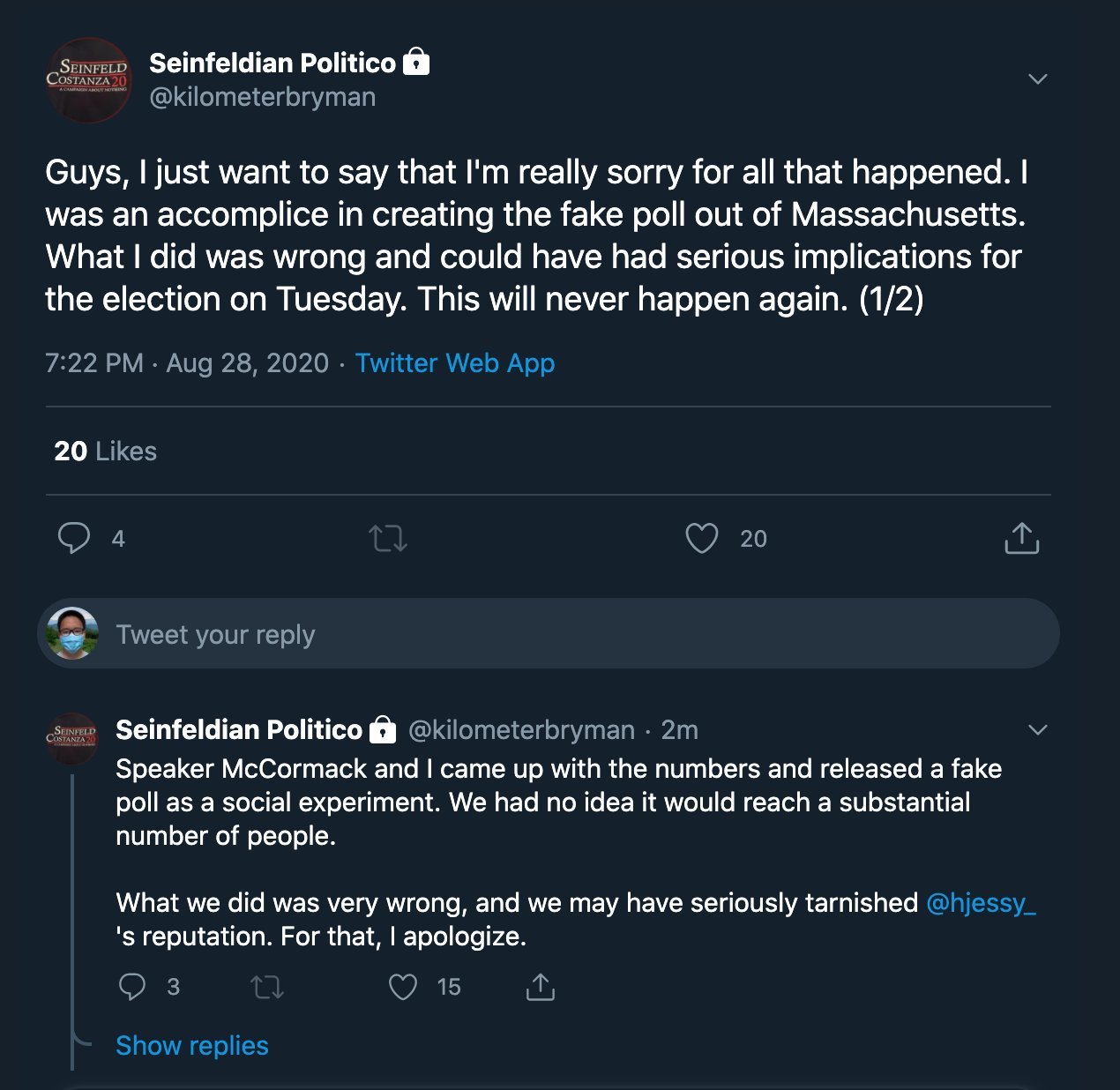
In a public apology preserved in the article, @Kilometerbryman wrote, “I was an accomplice in creating the fake poll out of Massachusetts.” A follow-up tweet said that the account and “Speaker McCormack” had devised the numbers and released the document as a “social experiment.” The account also apologized for the possible harm to Han’s reputation.
The reporting did not establish a political affiliation or a broader motive behind the fabrication. What it documented was how a familiar polling brand, plausible-looking graphics, and a personal connection helped false numbers reach an audience before they were publicly corrected.
First published on Elections Today. Originally published as “Multiple Twitter Accounts involved in faking the Massachusetts Gravis Poll.” This edition retains selected screenshots from the recovered article. Repeated graphics, blurry photographs of messages, speculative commentary, and obsolete download and promotional links have been omitted.
About the author: Gardner Thornhill is an analytics engineer and data analyst who builds data pipelines, predictive models, and interactive visualizations. Explore his case studies and other articles.